|
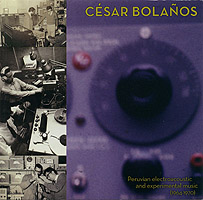
César Bolaños
- Peruvian Electroacoustic and Experimental Music (1964-1970)
 You
can count on the Pgus label to unearth electroacoustic treasures like
this one. This 2CD set culls the better part of the pure and mixed
electroacoustic oeuvre of César Bolaños, Peruvian composer and one of
the men behind the CLAEM studio (Peru’s first electronic studio in the
early ‘60s). His electroacoustic pieces are quite interesting and more
lively, in general, than what was coming out of the GRM at the time.
His works for instrument(s) and tape are occasionally less stellar,
although there’s a lot of meat around the bone. The two “Divertimento”
pieces are particularly fine, along with “Canción sin Palabras” for two
pianists and tape. If Bolaños looses sight of expression to get
entangled in concepts and mechanics, it is in his large-scape works
(“I-10-AIFG/Rbt-1” for performers, instrumentalists, projectionists,
etc.; “Ñacahuasa” for orchestra and recitator). Still, this is a great
production and a page of history about a little known repertoire:
South-American electroacoustic music. - Monsieur Delire You
can count on the Pgus label to unearth electroacoustic treasures like
this one. This 2CD set culls the better part of the pure and mixed
electroacoustic oeuvre of César Bolaños, Peruvian composer and one of
the men behind the CLAEM studio (Peru’s first electronic studio in the
early ‘60s). His electroacoustic pieces are quite interesting and more
lively, in general, than what was coming out of the GRM at the time.
His works for instrument(s) and tape are occasionally less stellar,
although there’s a lot of meat around the bone. The two “Divertimento”
pieces are particularly fine, along with “Canción sin Palabras” for two
pianists and tape. If Bolaños looses sight of expression to get
entangled in concepts and mechanics, it is in his large-scape works
(“I-10-AIFG/Rbt-1” for performers, instrumentalists, projectionists,
etc.; “Ñacahuasa” for orchestra and recitator). Still, this is a great
production and a page of history about a little known repertoire:
South-American electroacoustic music. - Monsieur Delire
"As
noted in Luis Alarado’s liner notes to this compilation, the music of César
Bolaños and his avant-garde Peruvian peers lacks the indigenous flavor
one might expect. Rather than rely on traditional sounds in new contexts, Bolaños
and others aimed for a new sound, one distinctly Peruvian not because of a looking
back, but due to a new movement forward. This two-disc set of Bolaños’
compositions contains work completed wholly during Bolaños’ time
in Argentina at the Latin-American Center of High Musical Studies (CLAEM). Bolaños
would return to Peru in 1973, but his career as a composer never quite regained
steam in his homeland, his focus turning more toward ethnomusicology, where
it remains to this day. These two discs, then, are more a snapshot than a career-spanning
set. But even if the album covers a scant six-year period, its scope, in terms
of tone and technique, is quite broad.
While at the CLAEM, Bolaños played a role in the birth of the center’s
electronic laboratory. “Intensidad y Altura,” however, is the only
track on either disc created solely via electronic sound. Magnetic tape is an
oft-utilized (and highly variant) voice in the music, augmented and accompanied
by pianos, small sets of woodwinds and percussion, and even a small orchestra
on “Ñacahuasu.” The tape is sometimes used to interject alien
electro-acoustic presence to a piece, such as the screaming synthesizer that
floats above the prepared pianos in “Canción sin Palabras, ESEPCO
II,” though it’s more often also a provider of the human voice. Given
the political bent of Bolaños’ work, this is vital. Ironically,
CLAEM was funded through the Alliance for Progress, which aimed to stem the
influence of communism in Latin American arts and culture, and Bolaños
was attuned to the views of the same guerillas and revolutionaries the program
was inaugurated to combat. “Ñacahuasu.” uses quote from Che
Guevara’s Bolivian diaries as the source of its text, an indication of
where Bolaños’ ideological interests lied.
Bolaños made use of computer-generated composition on a few of the included
tracks, but they don’t stick out from the rest, as Bolaños worked
in an abstract, unpredictable grammar anyway. “Flexum,” for woodwinds,
strings, percussion and tape, pits the instruments against each other in a game
of staccato ping-pong before introducing voices into the mix, stopping for an
unexpected call-and-response, and continuing on a trajectory hits on garbage-disposal
thick, and creepy emptiness; scanning through the piece’s 13 minutes uncovers
fragments seemingly unrelated to those that precede and follow. “I-10-AIFG/Rbt-1”
featured slide projectors, black lights, radios, and a computer-controlled system
of conducting based on illuminated signs. It’s one of the pieces on the album
that most obvious loses something in this single-media reproduction; other compositions
contain performative aspects lost in translation to an audio-only artifact, from
the theatrical vocal ejaculations of “Flexum” to the inclusion of a
mime(!) in “Sialoecibi (ESEPCOI).”
Whatever he was up to, Bolaños was an ever-adventurous composer. Despite
similarities to some of the iconoclasts who spoke and taught at CLAEM (Xenakis,
for one), Bolaños was a hard composer to pin down. His work could be grand
(the aforementioned “Ñacahuasu,” “I-10-AIFG/Rbt-1”)
or intimate (“Interpolaciones,” a spare duet for electric guitar and
tape), his instrumentation alien or organic, the tone serious and academic or
spontaneous and energetic. It’s no swipe at his talent to say that this issuance
of Bolaños’ work likely won’t be a revelation to fans of the
avant-garde, though it also must be said that this music is worth hearing not
just for curiosity or novelty alone. César Bolaños’ time as
a composer was short, and the legacy of his music has been, until now, localized.
This album is a window, then, into a marginalized corner of the history of experimental
music. That Bolaños is Peruvian is of interest to some listeners. That
his music is diverse and compelling should be of interest to many more. - By Adam
Strohm, Dusted Magazine
This double CD gathers a number of fairly important opuses by Peruvian composer
Bolaños, born in 1931 and part of a wave of local experimental musicians
who in the mid-sixties tried to encompass the demands of the avant-garde in their
approach to composition. The bulk of Bolaños’ activity occurred at
Buenos Aires’ CLAEM (Centro Latinoamericano De Altos Estudios Musicales),
where he was in charge of the development of the electronic music laboratory.
The man’s intellectual curiosity and will of juxtaposing different issues
in his scores – including theatre elements and experimentation with lights
and automated conduction – are both admirably illustrated by the material
contained herein.
As in every archival recording, a distinct smell of dust accompanies the procedures,
parallelly to the aura of naïve wholesomeness characterizing several of
these pieces. A well-visible ingredient in this artist’s work is the human
voice: “Sialoecibi, ESEPCO I” utilizes the recitation by a mime and
actor in a computer-and-piano setting, and texts from Ernesto “Che”
Guevara’s diary of the guerrilla campaign in Bolivia are mixed with an
amplified 21-element orchestra in “Nacahuasu”. The very first track
of this set, 1964’s “Intensitad Y Altura”, is a tape piece based
on a César Vallejo poem: it’s a haunting construction of chewed
mumbling, disjointed utterances and wet whispering, oddly recalling Frank Zappa’s
“Are You Hung Up?” on We’re Only In It For The Money (which came
three years later… honi soit qui mal y pense).
While “Divertimento I” and “Divertimento III” are instrumental
pastiches sounding like pretty ordinary improvisations, and “Interpolaciones”
constitutes an intriguing parallelism of cleanly dissonant (and occasionally twisted)
electric guitar plucks and pre-recorded abstractions, the most enthralling aspects
of Bolaños’ style lie in the somewhat sinister “Canción
Sin Palabras, ESEPCO II”, for piano with two performers and tape: its reverberant
shades, intimidating electronics and exploitation of the instrument’s insides
are fused with a classic of today’s EAI, namely the distant moan of the outside
vehicles during the live performance. Everything sounds current in this magnetizing
40-year old episode. Once again we owe a thankful bow to Pogus for having retrieved
and brought to our attention noteworthy and rather unique music, previously buried
in the soil of general unawareness. - Massimo Ricci, Touching
Extremes
A first definitive collection: A stunning cross-section of an underrated
composer.
Despite ranking among the key figures of the Latin American avant-garde movement
of the 1950s and 60s, the legacy of Peruvian composer and electroacoustic artist
César Bolaños never extended substantially beyond Peru and Argentina.
Using multimedia elements such as slide projectors, transistor radios, and sounds
meant to travel through multiple speakers placed around a performance space,
much of Bolaños work is impossible to experience in its entirety through
an audio recording. Yet even presented in this state of theatrical and conceptual
incompletion, César Bolaños — Peruvian Electroacoustic
and Experimental Music (1964-1970) offers a stunning cross-section of a
brilliant and underrated composer.
Spread over two discs, the music of the collection is taken from Bolaños’
years at Latin American Center of High Musical Studies (CLAEM) in Buenos Aires,
where he oversaw the development of the electronic music laboratory. The compilation
opens with “Interpolations,” a 1966 piece for electric guitar and
four-track tape in which pointillist guitar figures and string bends sound against
clouds of prerecorded metallic sounds. Intended as a spatial composition, in
performance, the guitarist would use a foot switch to direct the amplified sound
to speakers around the room.
In “Flexum,” woodwind clusters swell and recede over manipulated
tape, percussion, and strings bowed on the “wrong” side of the bridge,
creating a ghostly, otherworldly timbre. Even all-acoustic pieces like Divertimenti
I and III maintain a textural approach more akin to early tape collages than
“contemporary classical.” “Intensidad y Altura” is particularly
compelling—the only piece comprised entirely of electronics, the composition
is driven by gurgling found-sound manipulations, recordings of dinner conversation,
and rhythms of reversed vocal snippets
It’s difficult to ascertain exactly which acoustic elements are notated
versus improvised. Like the work of others of the period, including George Crumb
and John Cage, the music seems to be more about relationships of events happening
in time than traditional compositional curve and motivic development. Two of
the compositions—“ Canción sin Palabras, ESEPCO II” and
“Sialoecibi, ESEPCO I”—were co-composed with mathematician Maurcio
Milchberg, their melodic material derived from computer-generated algorithms.
That’s not to say that the music isn’t climatic or bombastic …
it certainly is. Violent atonal piano clusters, percussion lines, screaming
voices and magnetic tape counterpoints (particularly in the 14-minute masterpiece
“Canción sin Palabras, ESEPCO II”), or a combination of all
three make their way into most of the pieces here. But most of the compositions
seem built around murmuring conversational elements with jolting dynamic changes:
hits of piano and flute aleatorically punctuating tape sequences, trilling horns
and heavy percussion rolls rupturing quiet ambiances.
Listening to Peruvian Electroacoustic and Experimental Music (1964-1970), it’s
astonishing that Bolaños remains so obscure, even within the already
marginalized context of electroacoustic composition. This compilation, the first
definitive collection of the Bolaños’ work, illuminates a remarkably
innovative composer and musician, whose work is as emotionally resonant as it
is intellectually stimulating. One can only hope that this release gets his
music to more ears. - Hannis Brown, Tokafi
|